
Scouting Report: Aaron Judge
How I would attack baseball’s best power hitter.

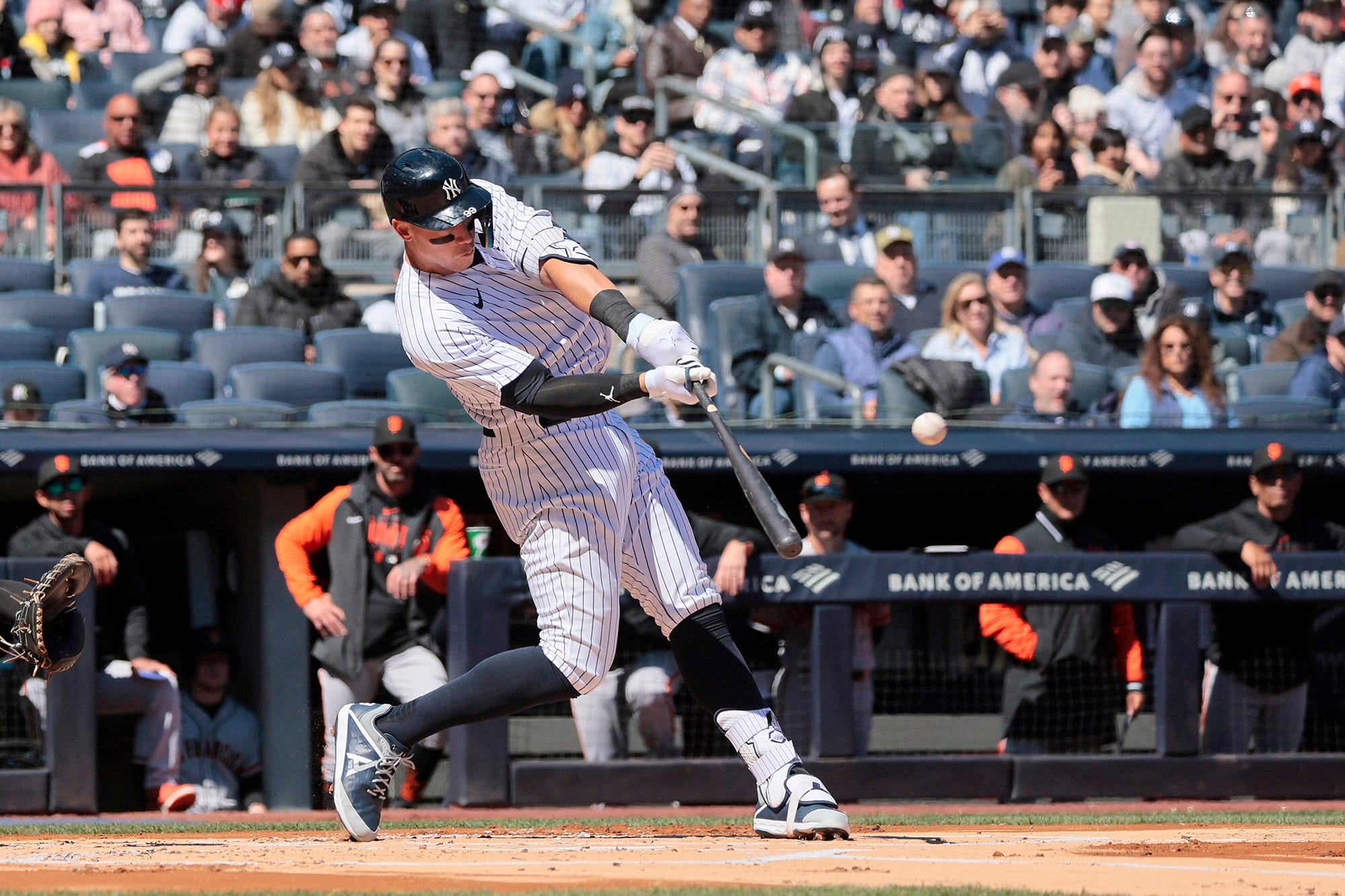
Currently leading the American League East by one and half games with a record of 78-56, the New York Yankees are looking to make their first Postseason appearance since 2022. Seeking their first World Series championship since 2009, the majority of the team’s offensive success this season has been driven by the dominant duo at the top of their lineup, Aaron Judge and Juan Soto.
Not only are Judge and Soto two of the best hitters in Major League Baseball, but they have also put together one of the best seasons by a 1-2 punch in Major League Baseball history. By measure of wRC+, only Babe Ruth and Lou Gehrig have been a better combination in the history of the American League than Judge and Soto, making the top of the Yankees lineup very difficult for opposing pitchers to pitch to. This article will look at how I would approach the tallest member of this dynamic duo, Aaron Judge, if I were an opposing pitcher.
Summary + Trends:

Aaron Judge has been producing another dominant season offensively in 2024, currently producing an unbelievable 225 wRC+ through 590 plate appearances. Compared to his 2022 season when he hit an American League record 62 home runs, Judge has been striking out less, walking more, and producing a higher quality of contact by the measure of xwOBA and Barrel%. At 77.0 MPH, Judge possesses the fourth-fastest average bat speed in all of Major League Baseball.
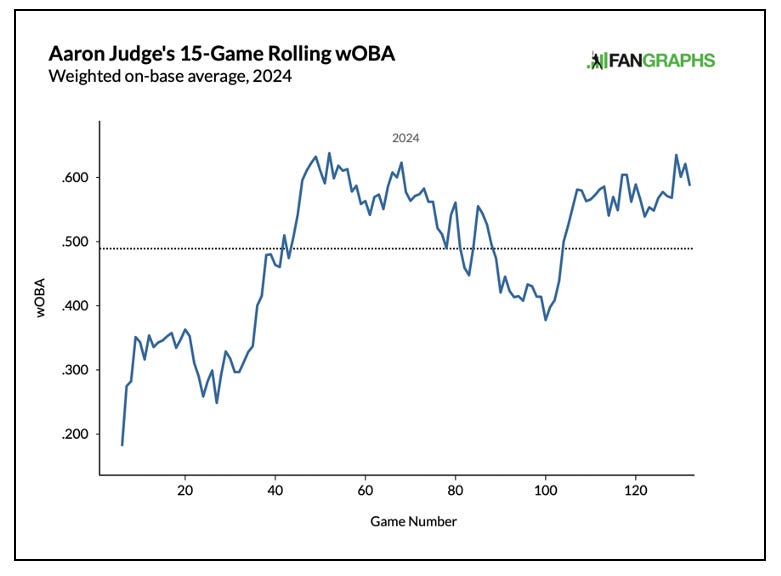
As shown by the rolling graph above, Judge has had an excellent season in terms of wOBA, and it appears that he is currently in his hottest stretch of the season. Judge has been on a tear during the month of August, producing a 292 wRC+ over 108 plate appearances. While there have been some peaks and valleys in the shape of Judge’s season, his “low point” of a .400 wOBA would be considered a “high point” for many hitters across Major League Baseball.
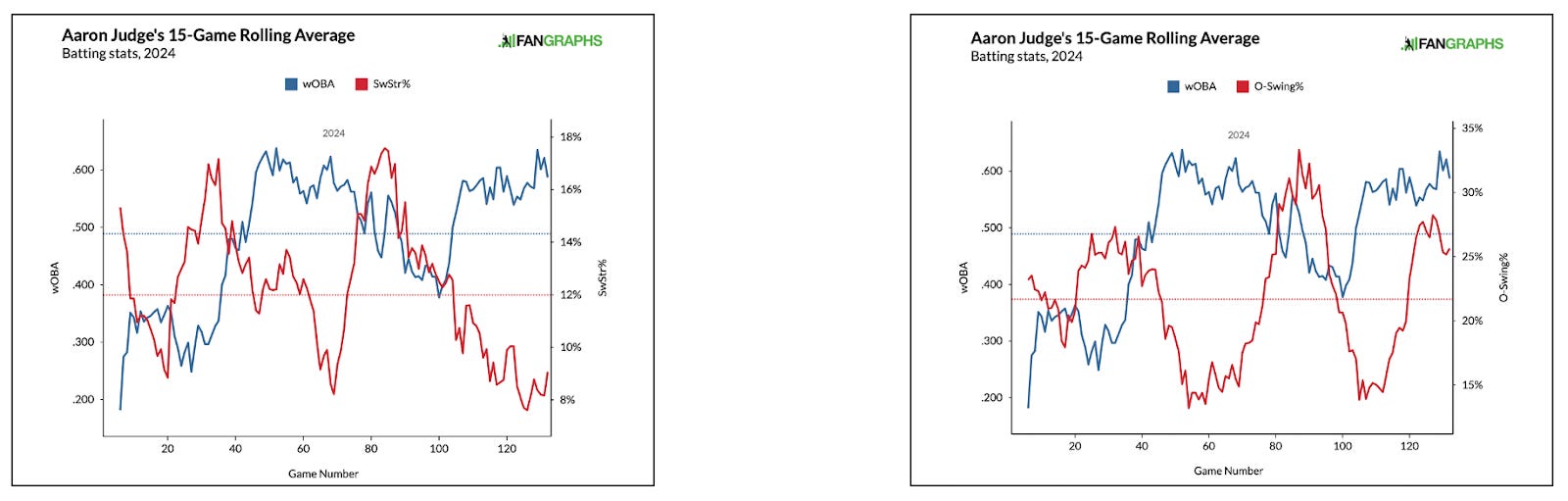
When overlaying Judge’s 15-game rolling SwStr% and O-Swing% with his 15-game rolling wOBA, two major trends emerge. First, there appears to be a significant inverse relationship between Judge’s swinging strike rate and his wOBA over the course of the season. When Judge swings and misses at more pitches, his overall level of production (as measured by wOBA) tends to increase. While this relationship may be intuitive, analyzing this relationship can be used as a means to identify when Judge is about to approach a slump and underscores the importance of getting Judge to swing and miss to minimize his ability to generate offensive production. While Judge’s rolling swinging strike rate has slightly increased over his past handful of games, the increase is not large enough to be indicative of a future decline in production. Second, there appears to be a looser relationship between Judge’s O-Swing% and his wOBA over the course of the season, indicating that Judge can struggle to produce offensively when he chases pitches out of the zone more frequently. Judge’s rolling O-Swing% had a strong relationship with his overall level of production early in the season, however, his rolling O-Swing% has increased during his recent stretch of peak production, indicating that this relationship is not as important as long as Judge is minimizing his swing-and-miss.
Game Plan:
Before proceeding into the game plan, here are a few notes about how I formulated this plan of attack. This analysis will be conducted from the perspective of a right-handed pitcher, and (to have a larger sample size) will be conducted using data from the entire 2024 season. Data regarding how well Judge performs against different pitch types has been scraped from Statcast, while the heat maps included in the analysis are from FanGraphs. This might result in some slight discrepancies regarding sample size, due to differences in how we define count situations. Barrel rate is approximated using the linked formula created by Alex Chamberlain. Data in this analysis is updated through the end of play on August 25th, 2024.
First Pitch (0-0):

On first pitch, Judge most often sees a four-seam fastball with pitchers utilizing the offering on first pitch 114 times this season. While Judge only swings at four-seamers 34.2% of the time on first pitch, he makes loud contact when he does decide to swing (37.5% barrel rate, .822 xwOBAcon). Utilizing a sinker instead of a four-seamer will allow more contact to Judge, but generates lower quality of contact (.444 xwOBAcon). Utilizing a slider or sweeper to Judge on first pitch can generate some swing-and-miss when he does decide to swing at these pitches.
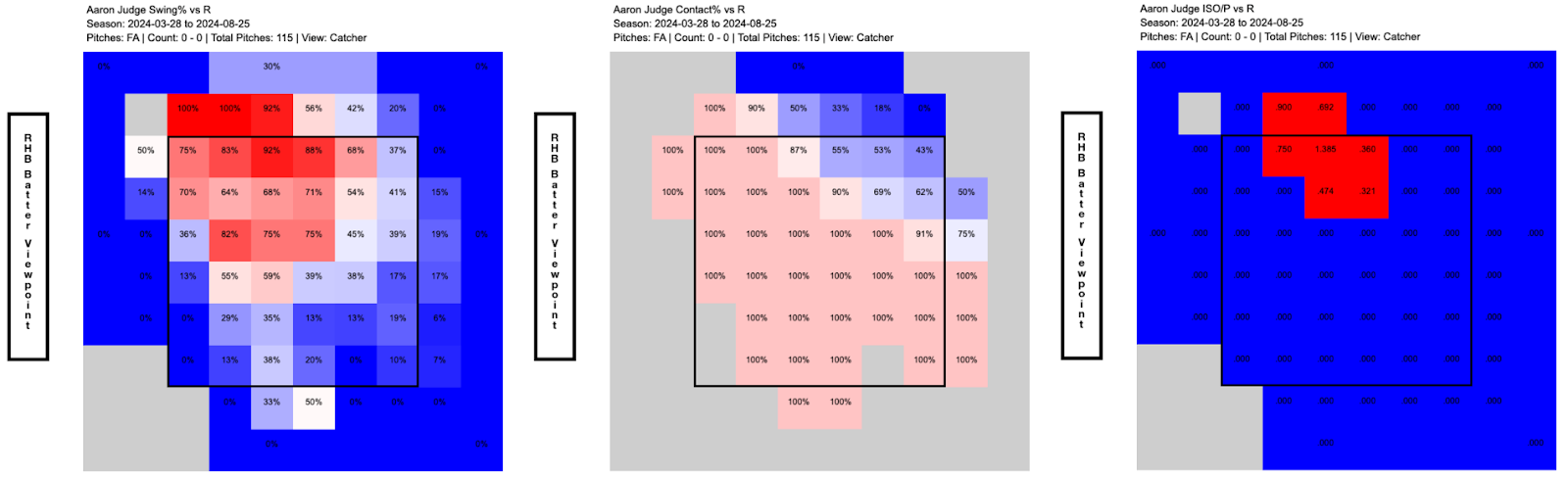
Utilizing a four-seam fastball to Judge on first pitch can be very dangerous, considering he is currently producing an 87.5% hard hit rate and 37.5% barrel rate when he makes contact on four-seamers in 0-0 counts. Judge’s “nitro zone” on first pitch appears to be up-and-in, where he frequently swings and makes contact on four-seam fastballs. Judge frequently takes four-seamers towards the bottom of the zone on first pitch, and perhaps a pitcher with a good feel for their four-seamer could utilize the offering in this part of the zone for a called strike. Judge does have some swing-and-miss against four-seamers up-and-away on first pitch, but pitchers should proceed at their own risk, as their “natural miss” will take the four-seamer right into Judge’s nitro zone.
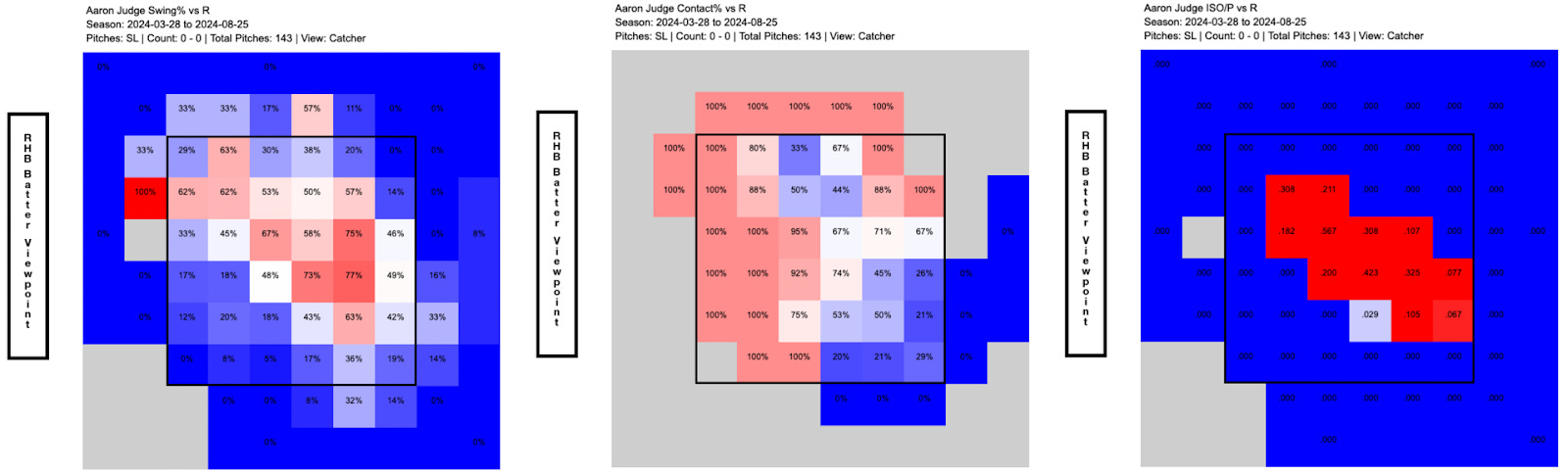
Utilizing a slider or sweeper down in the zone to Judge would be an effective option to generate either a called strike or swing-or-miss on first pitch. As shown by the heat maps above, Judge has displayed a propensity to take on sliders located low-and-in and has shown some swing-and-miss on sliders located low-and-away on first pitch. While there is some risk for damage in this area if Judge decides to swing and make contact, I believe that the frequency of generating strikes in this area of the zone outweighs the potential risks. It should be noted as well that Judge’s swing gets noticeably longer on first-pitch sliders and sweepers (9.0 vs. sweepers, 8.7 vs. sliders, compared to 7.7 vs. four-seam fastballs), potentially explaining his low contact rates against these pitches in 0-0 counts.
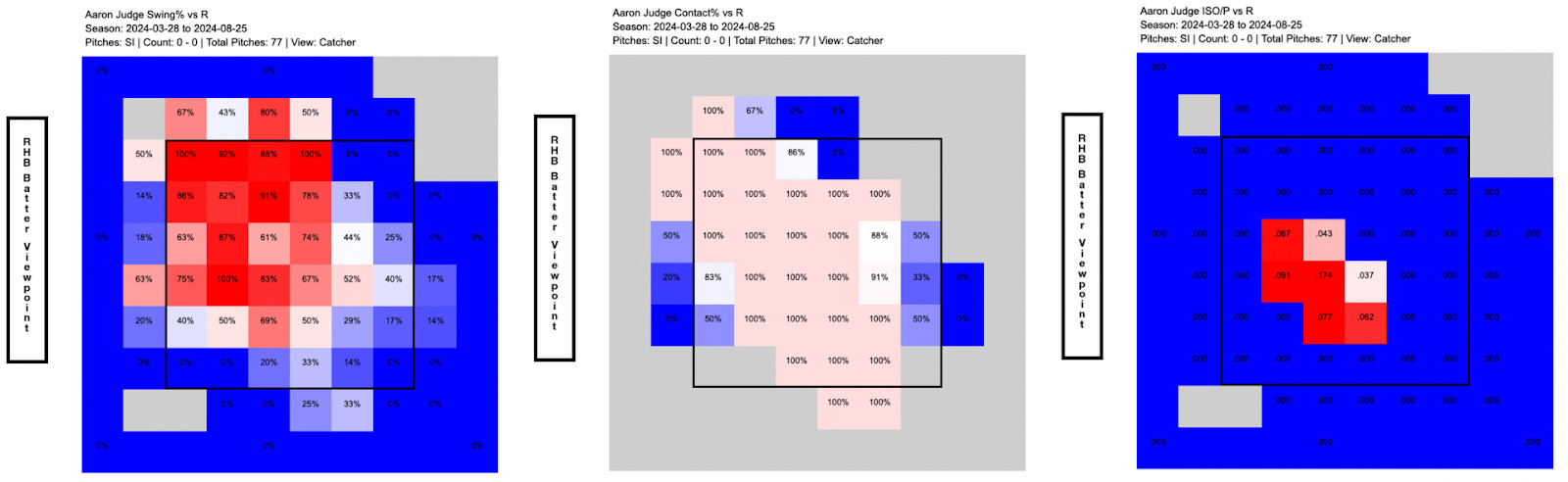
Utilizing a sinker on first pitch can be an intriguing option if the pitcher has a good feel for their sinker. While Judge displays similar swing tendencies against sinkers to his tendencies against four-seamers, he produces a lower quality of contact against sinkers on first pitch. Locating a sinker up-and-in could cause Judge to misidentify the pitch as a four-seamer, resulting in off-the-barrel contact, or the pitcher could utilize the pitch on the outer third of the plate to earn a called strike.
Pitcher Is Ahead (0-1, 0-2, 1-2):

When the pitcher is ahead in the count, Judge most often sees a four-seam fastball with pitchers utilizing the offering 122 times when ahead in the count this season. Pitchers have also frequently utilized sliders to Judge in these counts, as Judge is producing a 57.1% contact rate against these pitches when he is behind in the count. Opposing pitchers can also utilize a cutter to Judge in these counts to generate either called strikes or swing-and-miss.
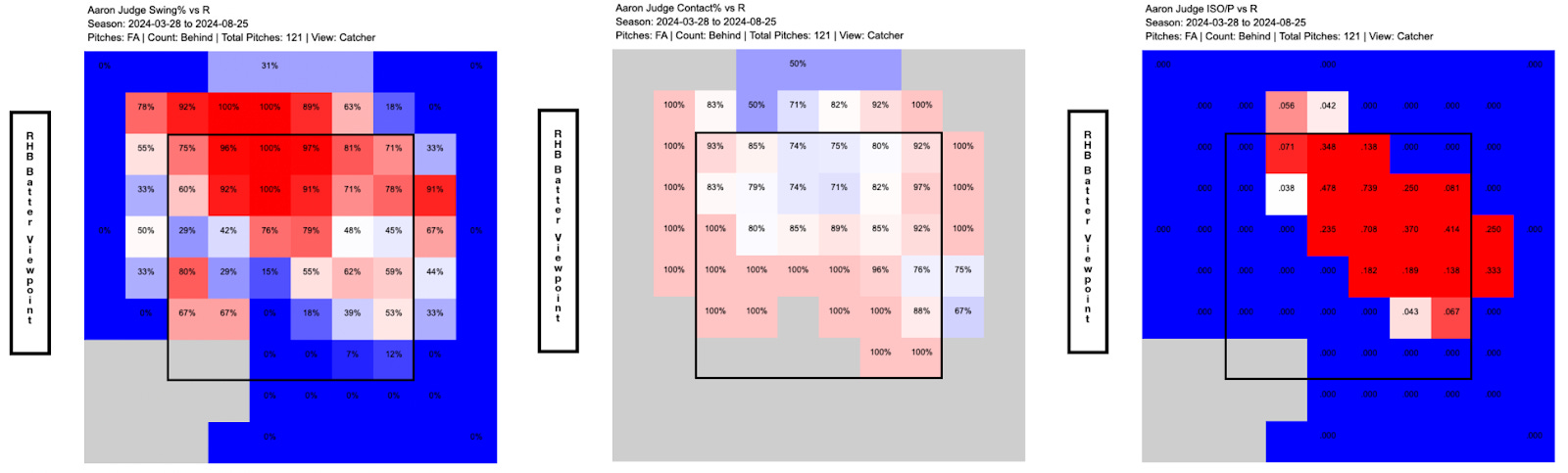
In these count scenarios, Judge’s nitro zone against four-seam fastballs appears to shift to up-and-away in the zone, as most of his damage against fastballs occurs on the outer third of the plate. There is some potential for generating swing-and-miss against Judge in these counts against fastballs up in the zone or above the zone, however, this is a high-risk, high-reward strategy as any pitch that leaks back into his nitro zone can be punished severely.
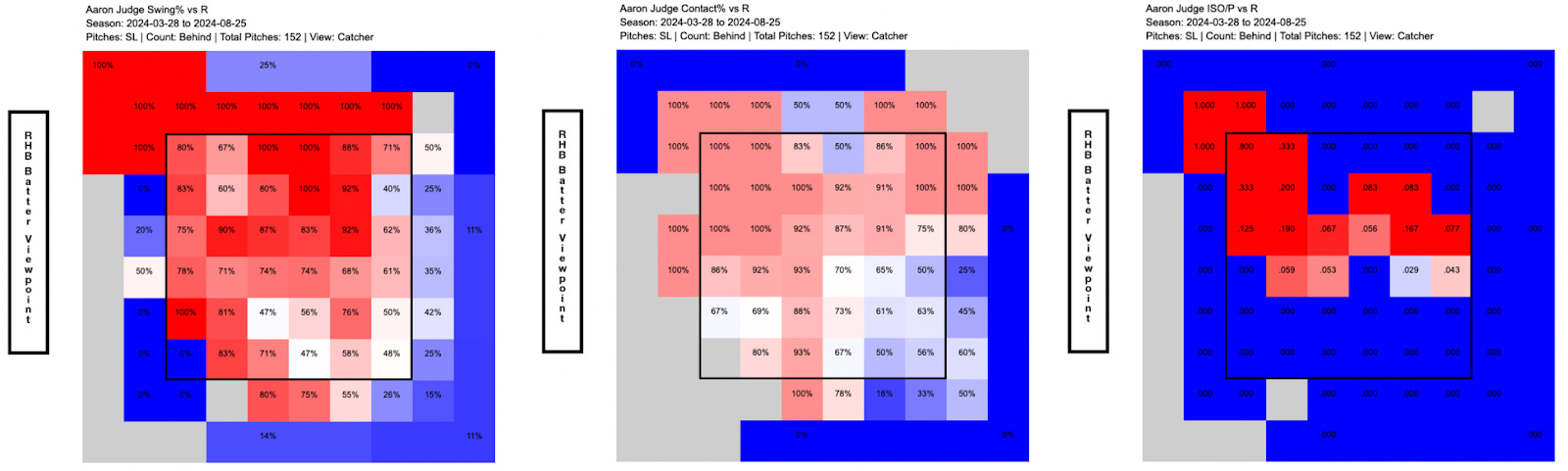
When the pitcher is ahead in the count, utilizing a slider can once again be an effective weapon to utilize against Judge. It is imperative that the pitcher keeps their slider down in the zone when utilizing the offering in these situations, as Judge does not generate much damage on sliders low in the zone. Judge has shown a tendency to swing-and-miss on sliders low-and-away, but he has displayed good zone awareness in this area of the zone, making it unlikely he will chase the pitch off the plate. Notably, Judge’s bat speed on sliders averages 71.8 MPH in these counts, compared to 74.3 MPH on four-seam fastballs, indicating that he likely sits on four-seamers in these counts and makes the necessary adjustments to make contact on breaking pitches. Judge is capable of creating damage on sliders when they are “hanging” in the top half of the strike zone.
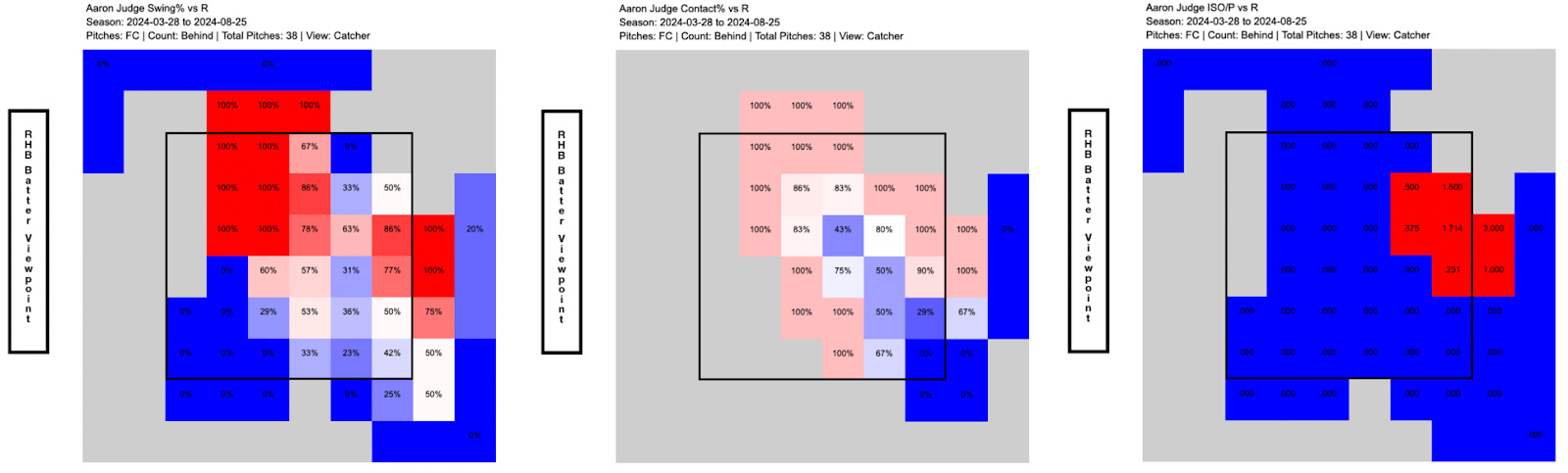
While Judge has only faced a cutter in these count situations 36 times this season, he has shown a weakness on low-and-away cutters, either taking them for called strikes or swinging and missing. Judge displays an elevated bat speed when facing cutters, averaging 76.1 MPH, which leads me to hypothesize that he views these pitches as fastballs out of the pitcher’s hand, resulting in swing and miss when the pitch moves in an unexpected direction. It is imperative to keep this pitch down, as Judge has produced hard contact on cutters located in the four-seamers nitro zone, up-and-away.
When Pitcher Is Behind (1-0, 2-0, 3-0, 2-1, 3-1):

When the pitcher is behind in the count, Judge most often sees a slider with pitchers utilizing the offering 101 times when behind in the count this season. Similar to other counts, Judge exhibits some swing-and-miss against sliders in these counts, with a 60.9% contact rate. Judge does not swing-and-miss much against four-seam fastballs in these counts, and generates hard contact with a 33.3% barrel rate and .873 xwOBAcon. Utilizing a right-on-right changeup could be an interesting high-variance approach for a right-handed pitcher in these situations, as Judge has a 45.8% contact rate and .933 xwOBAcon against changeups when he is ahead in the count.
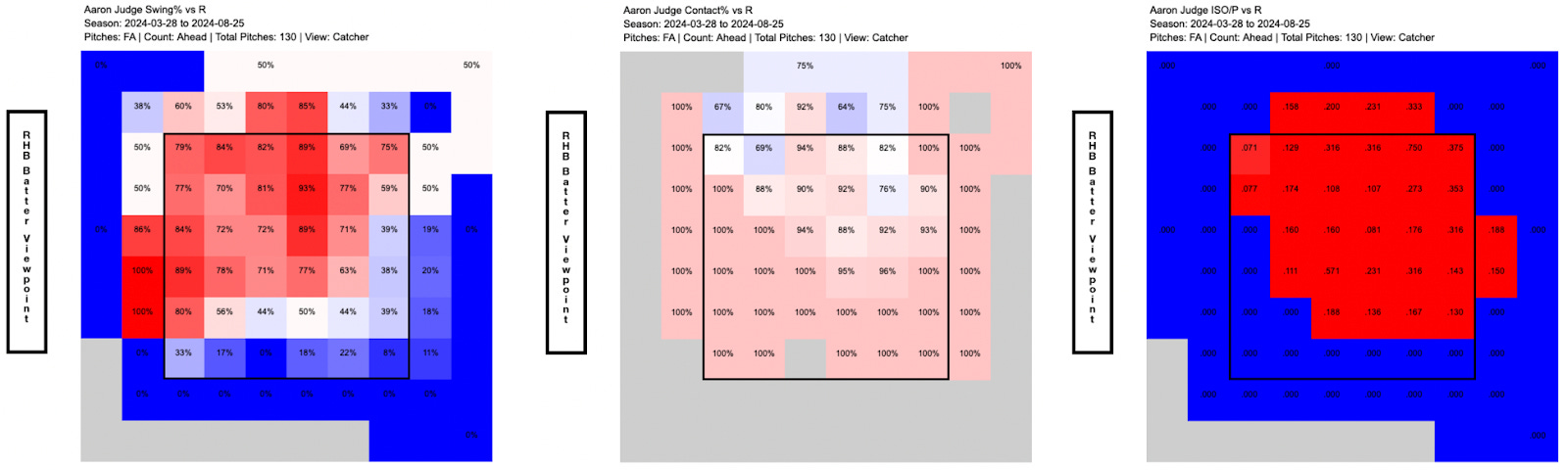
Simply put, Judge produces a lot of damage in the strike zone against four-seam fastballs when he is ahead in the count. As shown by the heat maps above, Judge makes contact on four-seamers throughout the strike zone and generates offensive production in nearly all areas of the strike zone. The only potential safe haven might be at the very bottom of the zone, where there’s a slight chance of stealing a called strike.
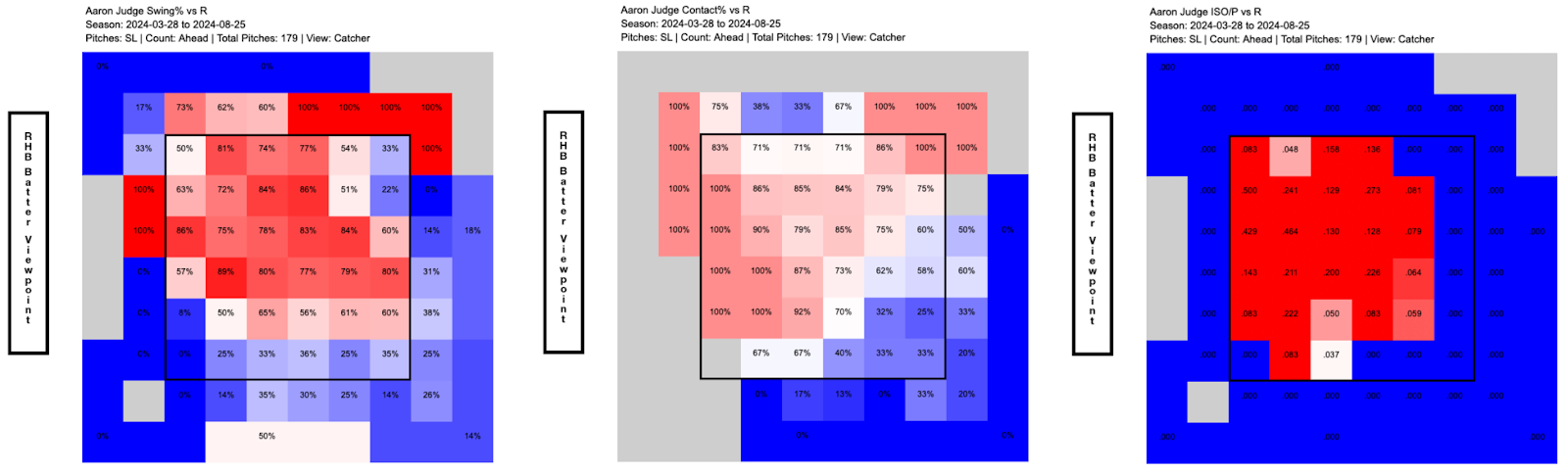
Even when Judge is ahead in the count, utilizing the slider against him remains a viable option. Similar to when he is behind in the count, Judge has displayed a tendency to swing-and-miss on sliders located low and away in the strike zone. It is imperative that the pitcher is able to hit his spot in these situations, as any slider that backs up or hangs over the middle of the plate is at risk of allowing impactful contact.
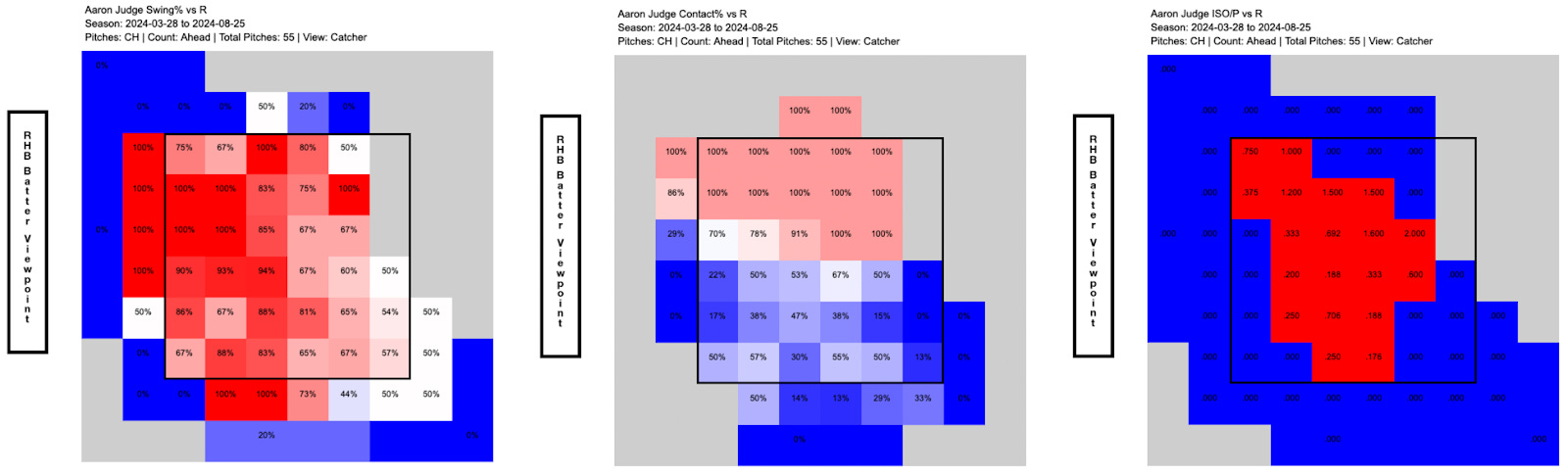
Surprising Judge with a right-on-right changeup is another viable strategy that a pitcher can utilize when they are behind in the count to Judge. As shown by the heat maps above, Judge displays significant swing-and-miss tendencies down in the zone against changeups when he is ahead in the count. It is also interesting to note that Judge takes his biggest swings against this pitch, averaging a bat speed of 78.3 MPH. A well-placed changeup in the lower half of the zone can be highly effective, but a mistake can be catastrophic, as evident by the .933 xwOBAcon that Judge has produced against changeups in these counts.
Even Counts (1-1, 2-2, 3-2):

In even counts, Judge continues to experience some swing-and-miss against sliders, producing a 73.8% contact rate against them in these counts. Judge’s hard hit rate against sliders is lower in even counts than in any of the other count scenarios. Utilizing a sinker can also be an effective pitch to use against Judge in even counts, as even though he produces an 86.1% contact rate against the pitch, his quality of contact against sinkers is lower than his quality of contact against sliders.
The heat maps on FanGraphs include first pitches (0-0) as “even” counts, so for the sake of consistency I will not be including their heat maps for this portion of the analysis. Upon perusing the heat maps for each individual even count, Judge exhibits similar tendencies against sliders that he does in other count situations, experiencing swing-and-miss when located down and away in the zone. If the pitcher has a good feel for their sinker, their best strategy in an even count might be to try to backdoor the offering, hoping for a called strike or weak contact on the outer edge of the plate.
Takeaways:
Be careful when utilizing the four-seam fastball - Judge will produce damage against the pitch when located up-and-in on first pitch, up-and-away when he is behind, and throughout the zone when he is ahead
Can generate swing-and-miss when utilizing the slider low-and-away. Can also generate a called strike when utilizing slider low-and-in on first pitch.
Will not chase too many sliders out of the strike zone (need to locate in-zone to generate swing-and-miss)
Biggest weakness is arguably against changeups when the pitcher is behind in the count. Lots of swing-and-miss at the bottom of the strike zone. R vs. R changeups are generally not common across the league, but I would strongly encourage utilizing the pitch at least once against Judge in this situation.
Aaron Judge is having one of the best offensive seasons in the history of Major League Baseball.
Thanks for reading!
Follow @MLBDailyStats_ on X and Adam Salorio on Substack for more in-depth MLB analysis. Photo credits to Charles Wenzelberg / New York Post.