
Understanding the Relationship Between Managerial Ejections and Winning Percentage
(8/26/22) Do managerial ejections fire up a team or are they indicators that the "wheels have fallen off"?

Originally published on Medium on August 26, 2022.
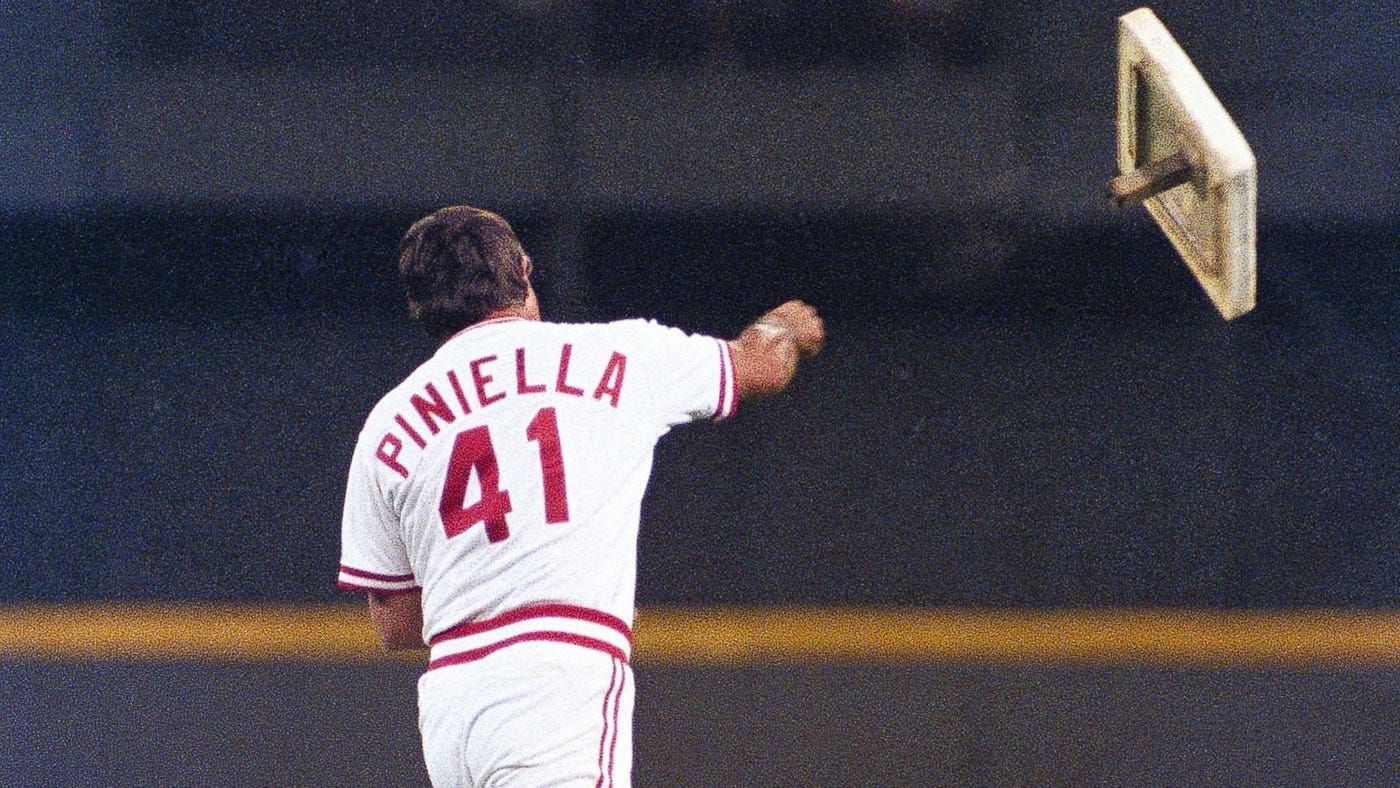
For many generations of baseball fans, one of the most entertaining elements of the game is watching a manager get heated, kick dirt on the umpires a la Lou Piniella, and get ejected. Many legendary managers, such as Earl Weaver and Bobby Cox, have large parts of their baseball legacy built around getting ejected and “firing their team up”. Some on the other hand, believe that a manager constantly battling with umpires and getting ejected is an indicator of a season gone wrong, and dysfunction within the clubhouse and the organization. Therefore, in this article I set out to answer the question — do managerial ejections “fire up” a team or are they indicators that the “wheels have fallen off”?
Background:
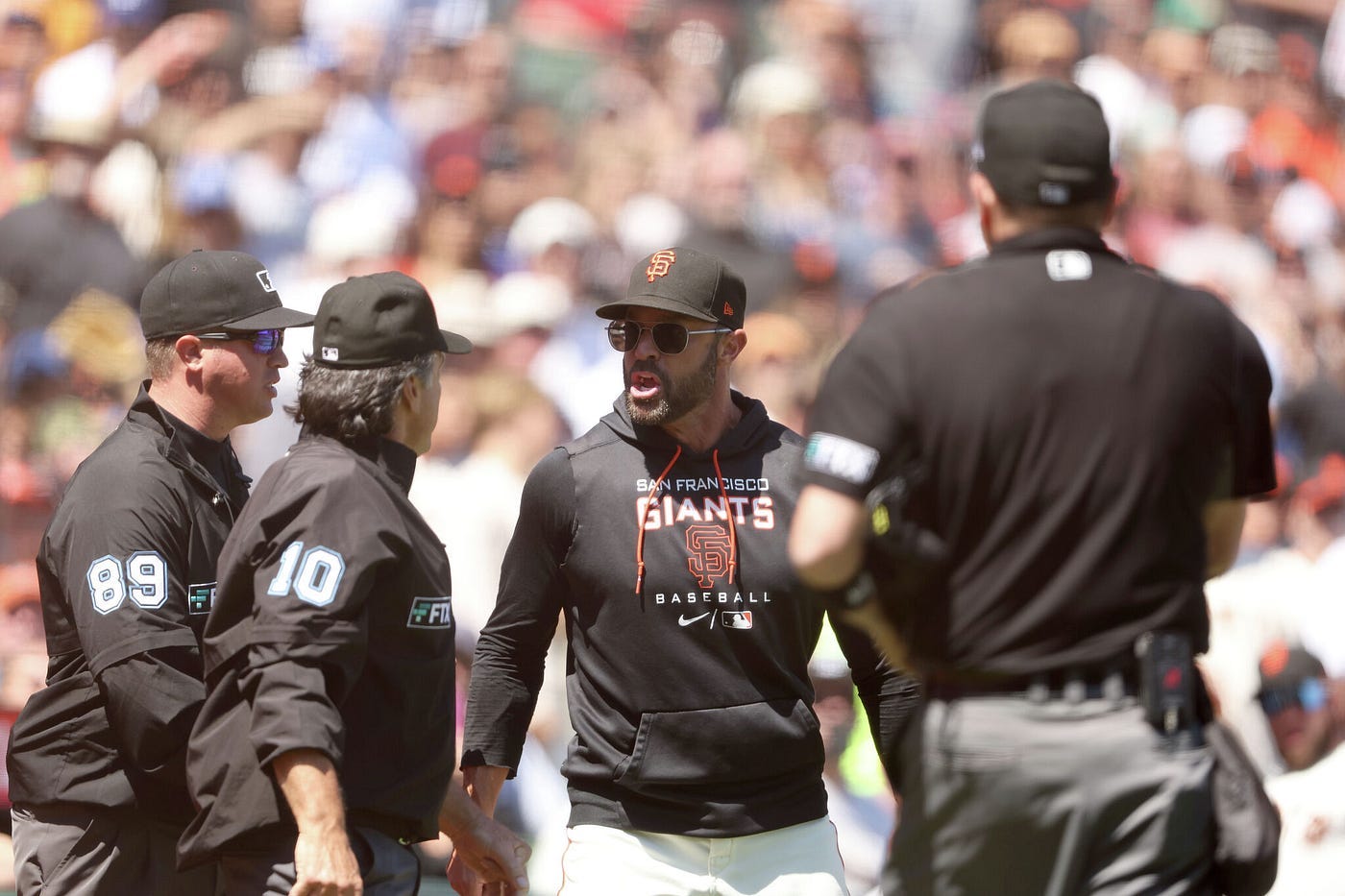
In a variety of different ways, the 2021 San Francisco Giants season was one of the most impressive single-season performances by a team in recent memory. Led by the team’s strategy of aggressive platooning and adherence to modern analytics and pitch design, the Giants led the National League with 107 wins. One of the more overlooked aspects of the team’s success last year is the fact that Gabe Kapler was not ejected one time throughout the entire season. In fact, in his three seasons as manager of the San Francisco Giants, Gabe Kapler has only been ejected once, on August 4th of this season. Observing how the Giants have been generally successful under the leadership of Kapler, this gave me the inspiration to analyze if there is a relationship between the number of managerial ejections and a team’s winning percentage in a given year.
Research:
For the purposes of this research, the assumption can be made that from a logical point of view, a team rarely achieves positive benefits from arguing a call. While it is possible that a team can use the ejection of their manager as a “rallying point” in an attempt to stage a late-game comeback if the team is behind, arguing with a call (whether blown or not) will most likely result in the team forming a negative relationship with the umpiring crew. While Major League umpires as a whole do a good job at remaining impartial, as human beings, it is only natural for a team that has been harassing the umpire throughout the game to receive fewer “borderline” calls in their favor. In addition, by preventing ejections and managing the full game, this allows the team to remain under one leader and one unified strategy, as opposed to the bench coach “switching things up” when they are the interim manager. This appears to be a strategy of Gabe Kapler in particular, because throughout his five year career as a Major League Baseball manager, he has only been ejected five times, four of which occurred during the 2019 season as manager of the Philadelphia Phillies. Also, an increase in managerial ejections may indicate that the “wheels have fallen off” a given team, as under-performing preseason expectations may cause tempers to rise in the dugout and boil-over via managerial ejections and further poor play on the field. By analyzing the relationship between managerial ejections and winning percentage, I seek to provide more clarity as to why ejections occur and their subsequent on-field impact.
In order to test whether or not there is a relationship between these two variables, a linear regression will be run in order to identify whether or not there is a statistically significant relationship. The dataset used for this analysis will be managerial ejections and winning percentage per season, by team, since the start of the 2014 MLB season when the current system of instant replay was implemented, through the 2021 MLB season. This date was used as a starting point, as the advent of instant replay changed the nature of arguing calls, which theoretically would affect the number of ejections per season. Due to the shortened season, data from the 2020 MLB season was excluded from the dataset.
The linear regression using Winning Percentage as the y-variable, and Number of Managerial Ejections as the x-variable resulted in the following:
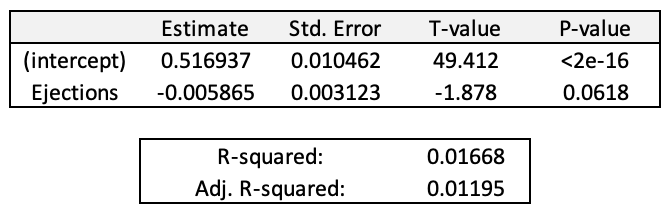
With an R-squared value of 0.01668, this linear regression indicates that 1.67% of the variation in winning percentage can be explained by managerial ejections. This extremely low R-squared value is to be expected, since it would be wildly unrealistic to expect managerial ejections to be the sole determinant of a team’s winning percentage. The P-value of 0.0618 is of great interest to this research, because this indicated that there is indeed somewhat of a statistically significant (negative) relationship between managerial ejections and a team’s winning percentage. To better demonstrate these findings, I constructed a graph in R that illustrates this relationship.
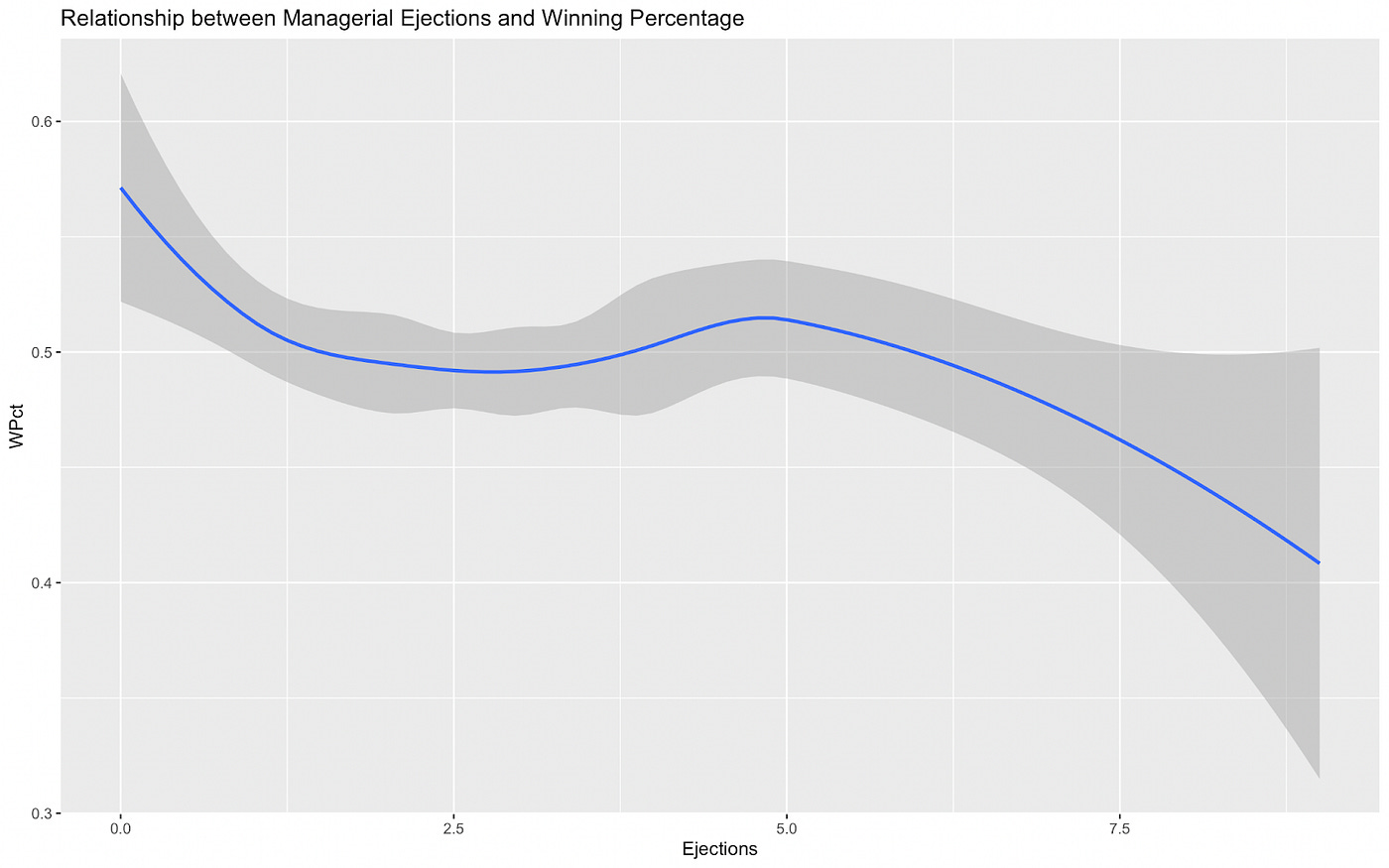
As this line graph shows, managers that have fewer ejections, in general, will have a higher winning percentage over the course of a given season. This gives credence to the theory that managerial ejections indicate that the “wheels have fallen off” a given team.
To further prove this hypothesis, displayed below is a table of average winning percentage per amount of ejections this season.
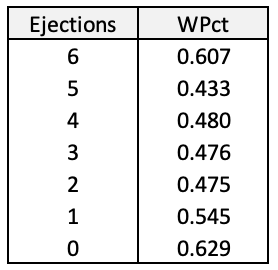
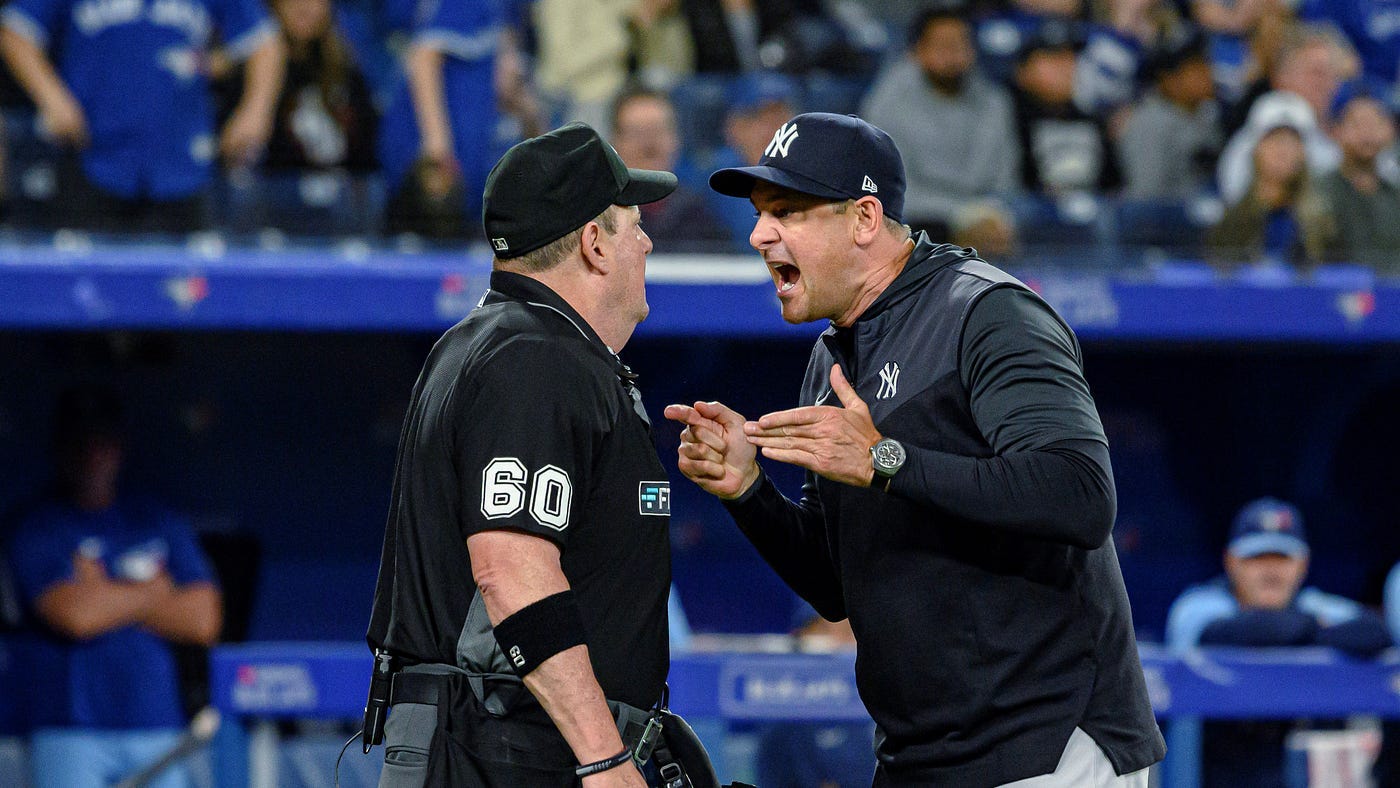
This table largely proves the theory that less managerial ejections leads to a higher winning percentage with one notable outlier, the six ejections from Aaron Boone of the New York Yankees this year. However, upon further evaluation, this outlier only further proves the theory that an increase in managerial ejections indicated that the “wheels have fallen off”. The table below displays when Boone’s ejections occurred this season alongside the team’s winning percentage at the time.
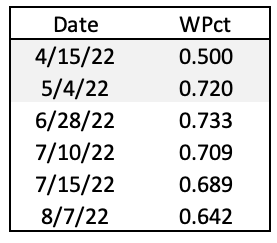
After starting off the season with a 50–17 record, the Yankees have gone 27–31 since June 21st. 4 of Aaron Boone’s 6 ejections this season have occurred over that span, once again providing credence to the theory that an increase in managerial ejections indicates that “the wheels are falling off”.
Conclusions:
After analyzing the relationship between managerial ejections and winning percentage since the 2014 season, it can be concluded that there is somewhat of a statistically significant relationship between these two variables and that an increase in managerial ejections generally indicates that the “wheels have fallen off” a given team. As mentioned previously, Gabe Kapler did not have an ejection during the San Francisco Giants successful 2021 season, and also did not have an ejection during the 2020 season in which they outperformed expectations. The only seasons in which he has had at least one ejection? In 2019 (as manager of the Phillies) and 2022, both seasons in which his teams under-performed expectations. Aaron Boone of the Yankees leads Major League Baseball in ejections this season, with a majority of them occurring during the 27–31 slide the team is currently on. In conclusion, managerial ejections appear to be either an indicator or a genesis of a team’s poor performance and while it may be necessary in some instances, it is imperative for a team’s success that their manager is ejected as little as possible over the course of a season.
Follow @MLBDailyStats_ on X (Twitter) for more in-depth MLB analysis. Statistics provided by Baseball-Reference.