
Introducing My Stuff+ Blob
Visualizing the effects that velocity, release point, and movement characteristics have on pitch quality.


Last month, I released the first version of my pitch quality model aStuff+, as detailed in the article Introducing My Stuff+ Model. In addition to creating a model that could be used to evaluate and predict future performance of Major League Baseball pitchers more effectively, another objective of creating the model was to conduct other research projects involving aStuff+, such as evaluating how altitude and environmental factors may affect aStuff+ in my recent article Average aStuff+ by Park and Hitter Leaderboards. Creating a “blob” Shiny app to better understand how well a given pitch may grade in my model was an important piece of research I wanted to conduct and I am excited to finally deploy the aStuff+ Blob App.
The Blob App will allow the user to filter by velocity, release point, and extension to approximate the aStuff+ of a pitch as grouped by horizontal and vertical movement. Utilizing a “blob” is particularly useful in player development and pitch design, as it is important to know how well a given pitch is going to perform before either adding an offering to a pitcher’s arsenal or making an adjustment to an existing pitch. The Blob App can also be utilized to better understand why certain pitches perform better in my pitch quality model than others.
For example, the app can be used to analyze the effect that increasing velocity has on lowering the minimum induced vertical break needed for having a plus Four-Seam Fastball as measured by aStuff+:
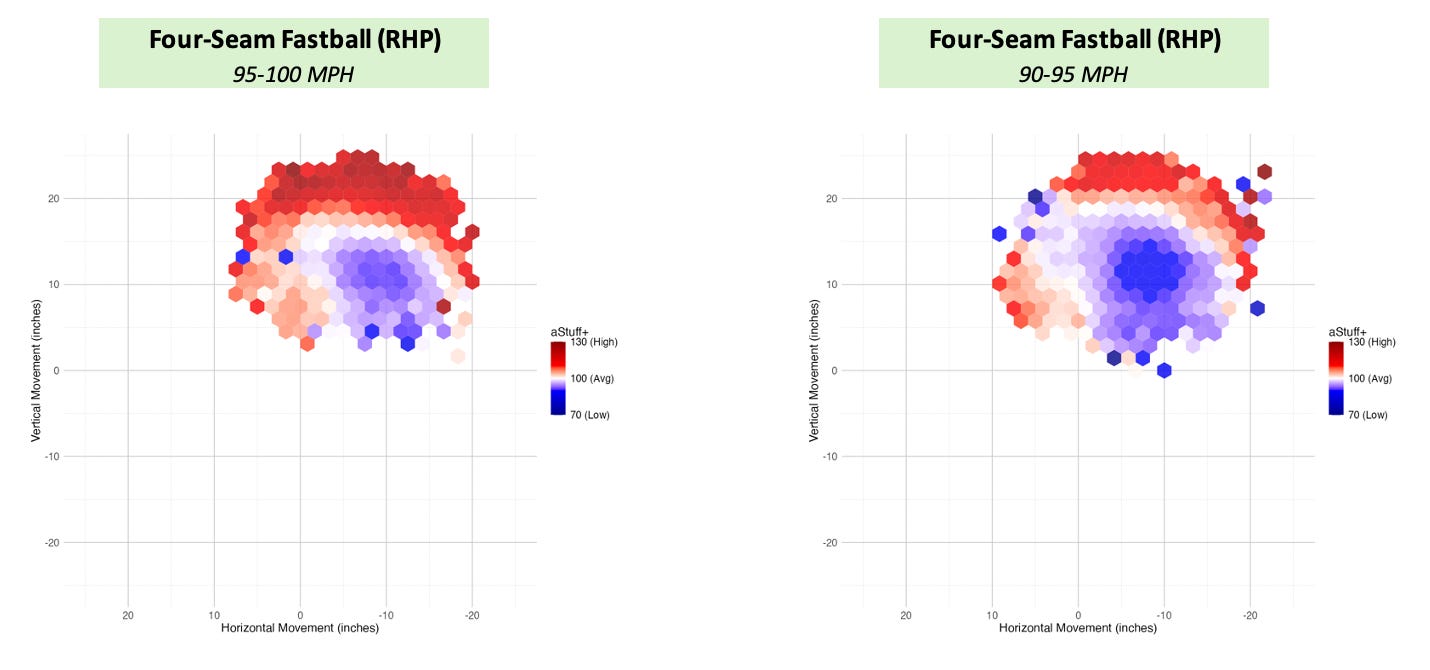
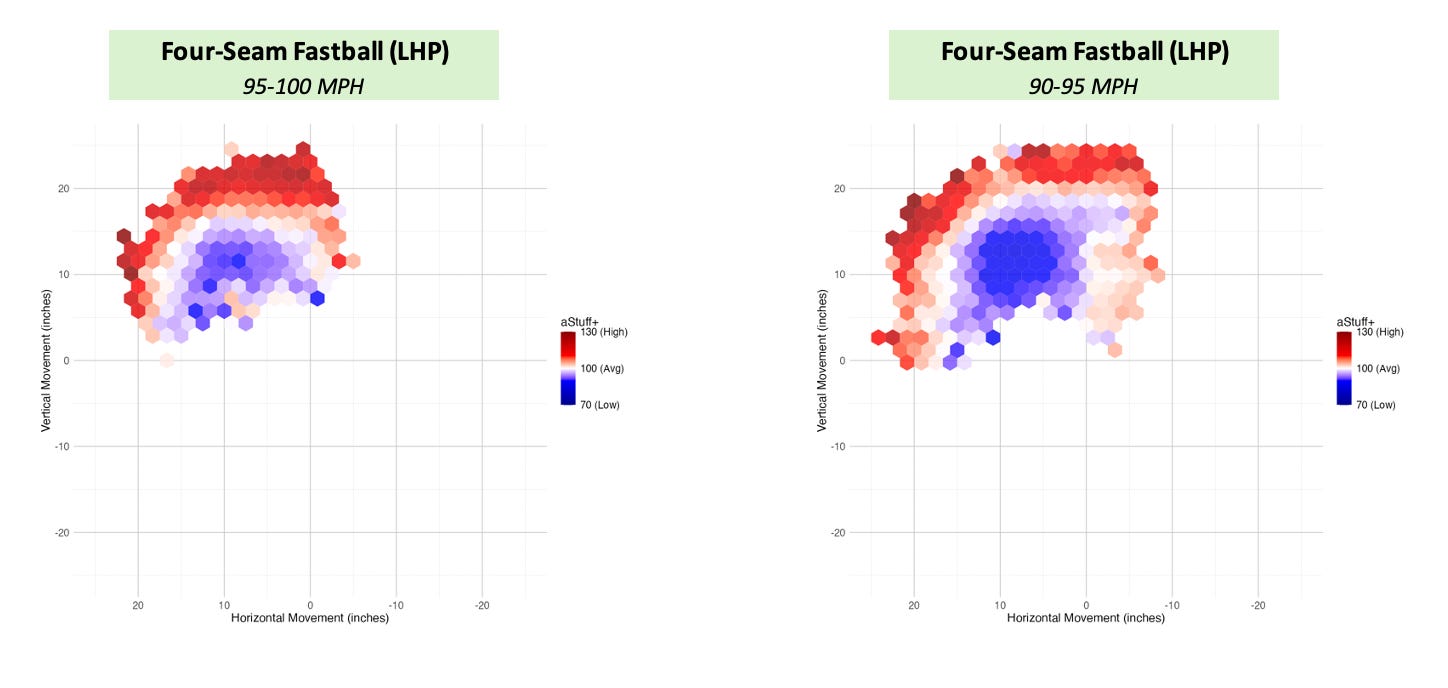
The app can also be utilized to display the importance of throwing Sliders with velocity, as aStuff+ indicates that pitchers are likely better off attempting to throw a Sweeper if they can not throw their Gyro Slider at least 85 MPH:
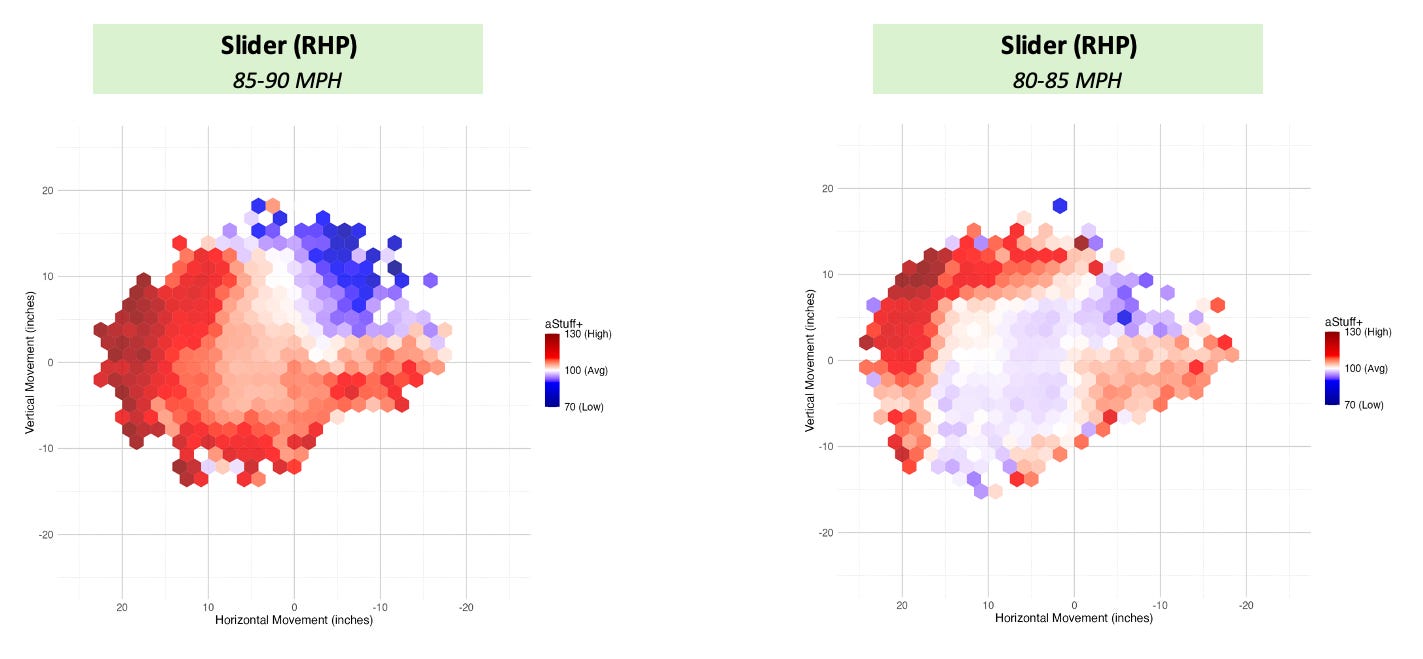
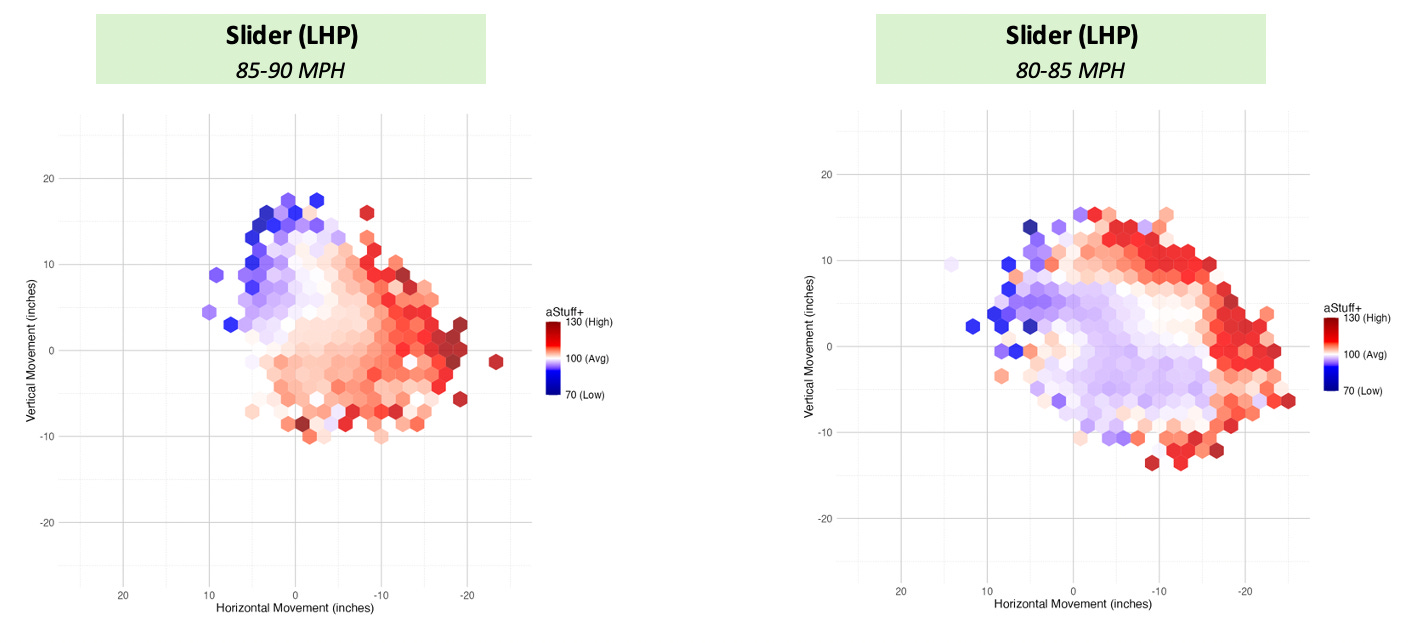
These are just two examples of how the aStuff+ Blob App can be utilized to analyze the projected pitch quality of certain pitch types. To my knowledge, the aStuff+ Blob App is currently the only “blob” that is currently available to the public that is not behind a paywall. I am looking forward to using the “blob” in my analysis moving forward (especially as it pertains to pitch design), and hopefully, it will become a useful resource that can be used to further improve our process of pitching analysis.
Thanks for reading!
Follow @MLBDailyStats_ on X and Adam Salorio on Substack for more in-depth MLB analysis. Photo credits to Getty Images.